
Innovation environnementale, technologie et solutions locales pour les exploitations agricoles
Projets ALUS

ALUS - Working to Promote Biodiversity
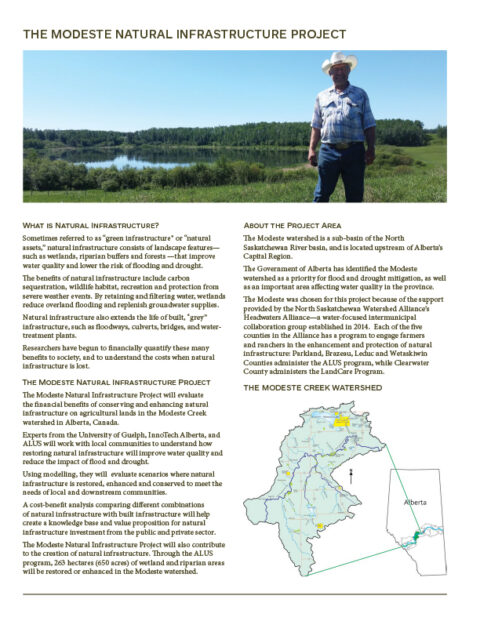
Modeste Natural Infrastructure Pilot Project Overview
Modeste Natural Infrastructure Pilot Project Results
Ecometrics Analysis Summary Report: Lake Winnipeg Water Stewardship Pilot Project
Guides ALUS
Success with ALUS Enhanced Grazing Projects - Western & Prairies Hub
Success with ALUS Tree and Shrub Projects - Western Hub
Success with ALUS Wetland Projects - Western Hub
Réussir la lutte contre l’érosion avec ALUS
Réussir l’aménagement de prairies avec ALUS
Réussir la plantation d’arbres et d’arbustes avec ALUS
Réussir l’aménagement de zones humides avec ALUS
Assurer la surveillance des projets d’aménagement de prairies ALUS
Assurer la surveillance des projets d’aménagement de zones humides et de lutte contre l’érosion ALUS
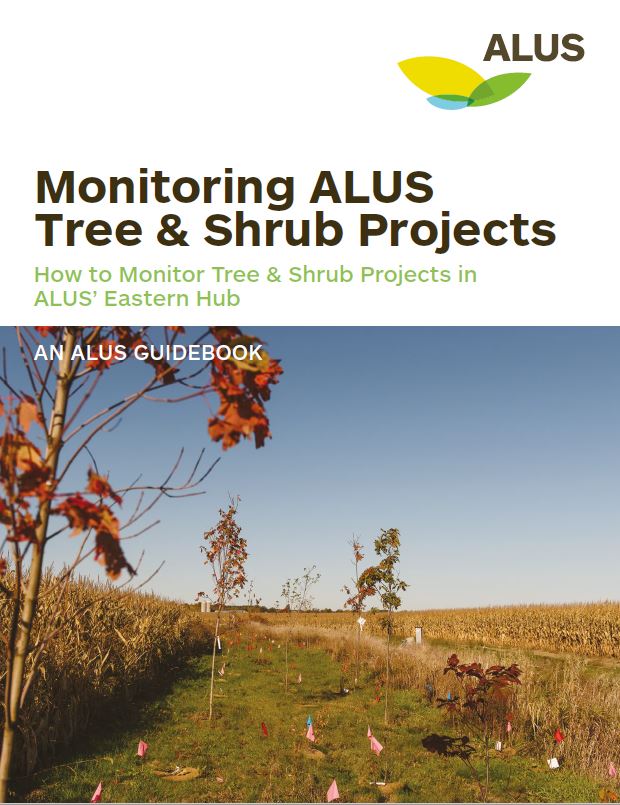
Assurer le suivi des projets ALUS – Comment favoriser la pérennité des projets ALUS au Québec et en Ontario
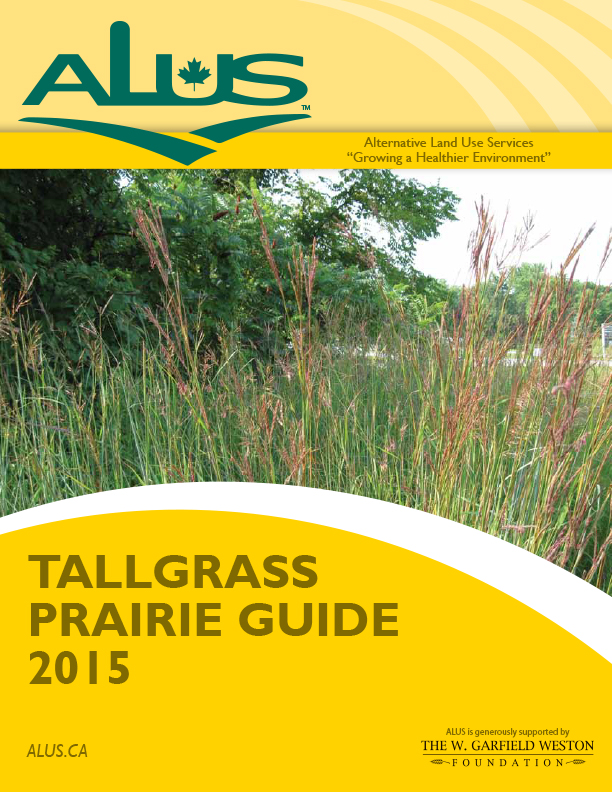
Tallgrass Prairie Guide - Eastern Hub
Feuillets d’information ALUS
Helping Aquatic Species at Risk: Bigmouth Buffalo
Helping Aquatic Species at Risk: Carmine Shiner
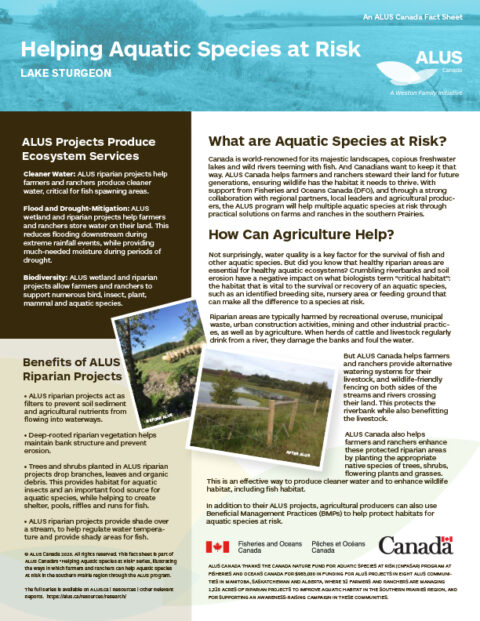
Helping Aquatic Species at Risk: Lake Sturgeon
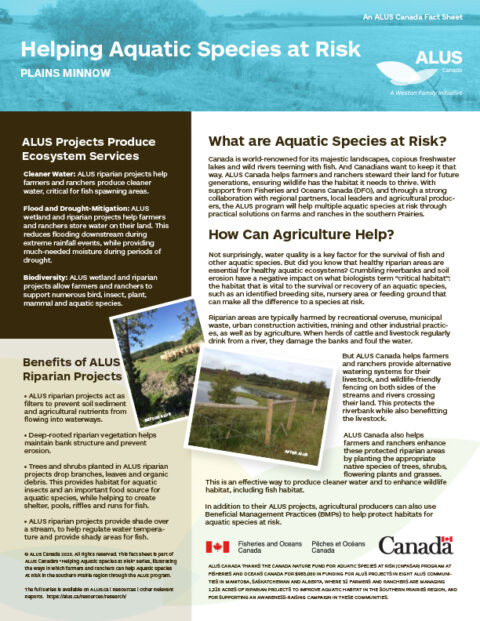
Helping Aquatic Species at Risk: Plains Minnow
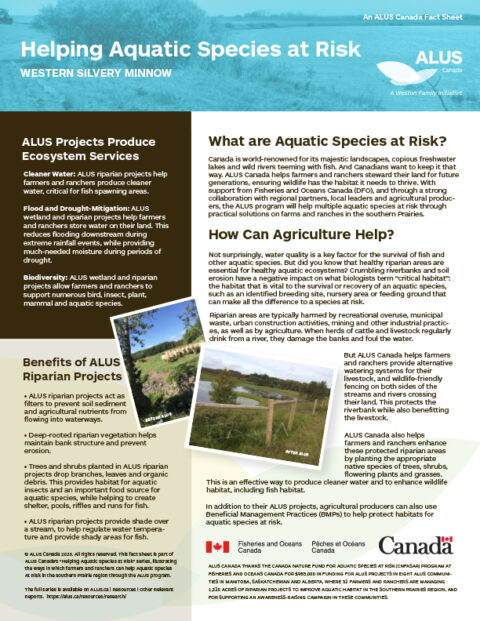
Helping Aquatic Species at Risk: Western Silvery Minnow
Recherches ALUS
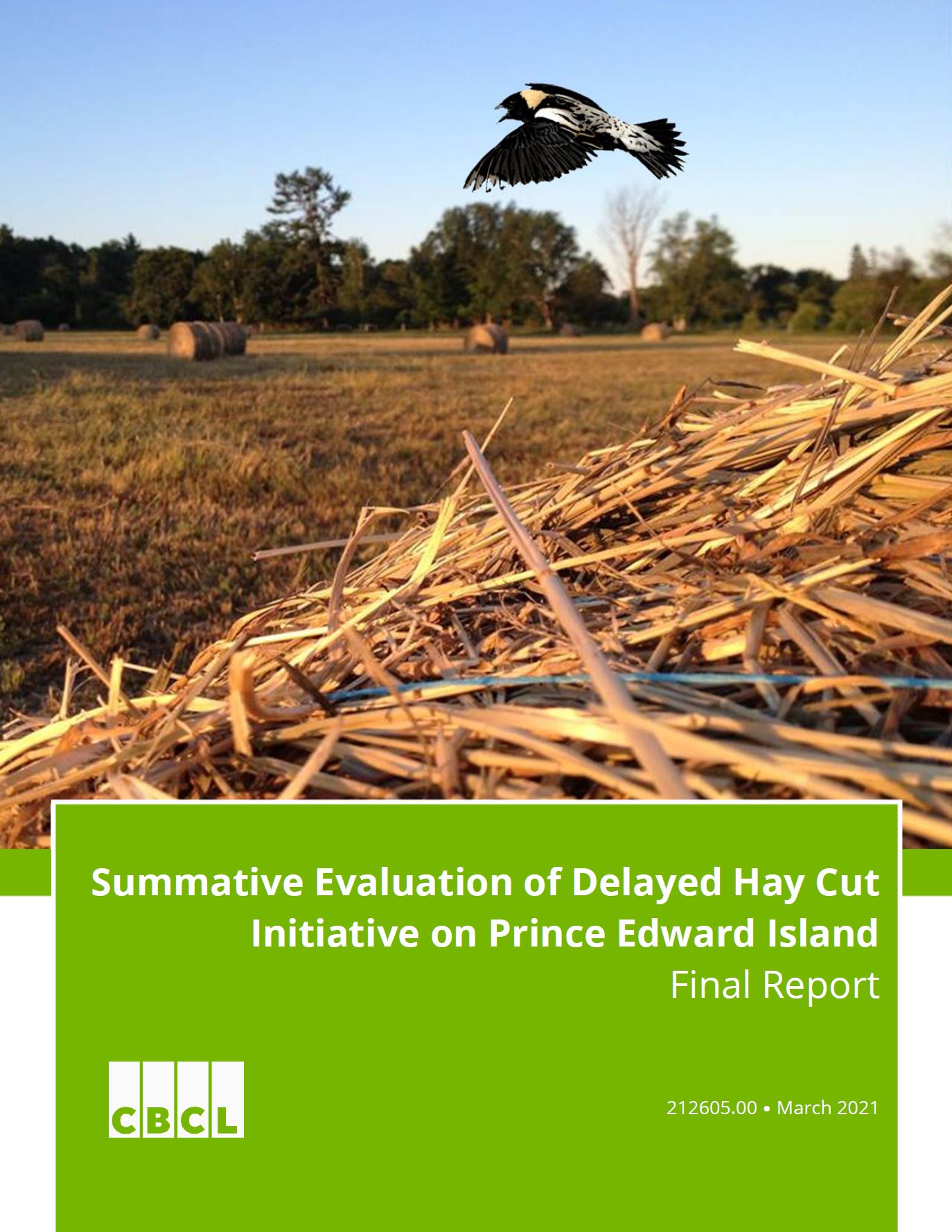
Summative Evaluation of Delayed Hay Cut Initiative on Prince Edward Island - Final Report
Report by CBCL Limited (2021)
Alternative Land Use Services (ALUS): A benchmark survey of public opinion on the environment in relation to farming and the quality of life in Norfolk County
Survey Report by Bob Bailey and Loreley Greenslade, Ecometrica Communications (2005)
Alternative Land Use Services (ALUS): A Preliminary Overview of Potential Cost Reductions and Financial Benefits to Canada
Report by Tyrchniewicz Consulting (2007)
Alberta Innovates: Cost Assessment of Ecosystem Services Procurement
Report by Alberta Innovates Technology Futures (2016)
Assessment of Potential Biodiversity Market Partnerships in Ontario-Amoveo Report ENBUS group
Research Project for the class of Pr. Goretty Dias, University of Waterloo (2012)
A Benefit Transfer Tool for Valueing Nature’s Benefits to Society from ALUS Farmlands
Report by EcoRessources (2013)
Community composition of pollinating insects on farms enrolled in Alternative Land Use Services in Norfolk County, Ontario
Research by Courtney Irvine, University of Guelph (2013)
Expansion of the Pollination Service Measurement (PSM) concept in Southern Ontario
Research by Tom Woodcock et al., University of Guelph & Seeds of Diversity (2013)
An analysis of the critical success factors for participation in agricultural – environmental program: A case study
Thesis by Jessica Rosenburg, University of Guelph (2010)
Grassland Carbon Sequestration Offset Protocol Framework
Report by EcoRessources (2011)
Payment for agro-ecosystem services: Developmental case-history descriptions of Canada’s Grassroots ‘ALUS’ Programs
Research by Robert L. France and Jeffrey B. Campbell, Research Journal of Agriculture and Environmental Management (2015)
Small Restoration, Big Impacts: How Habitat Influences Native Pollinators in Intensive Agricultural Landscapes
Thesis by Caitlin Paterson, University of Guelph (2014)
Investment in the Provision of Ecological Goods and Services on Private Rural Land in Ontario: A Framework for Policy Development
Thesis by Paul Guerra, University of Guelph (2010)
Studies of Bobolink and Related Bird Habitats on Agricultural Lands in Norfolk County
Report by Jon McCracken (2014)
Supporting Environmental Stewardship and Livelihood Benefits in Ontario’s Greenbelt: Assessing the Potential Contribution of the Alternative Land Use Services Program
Thesis by Bruce Mackenzie, University of Waterloo (2008)
Case Study Series: Local Best Management Practices in Agriculture
Council of the Great Lakes Region, Bruce Power, Climate Risk Institute (2021)
Autres recherches
Biens et services écologiques
EG&S: Estimating Program Uptake and the Nature of Costs and Benefits
George Morris Center (2007)
EG&S: Estimating Program Uptake and the Nature of Costs and Benefits in Agro Manitoba
George Morris Center (2009)
Estimating Ecosystem Services in Southern Ontario
Spatial Informatics Group, Austin Troy & Ken Bagstad (2009)
Estimating the Value of Natural Capital in the Credit River Watershed
The Pembina Institute and Credit Valley Conservation (2009)

Funding Natural Capital – Determining the Desired Characteristics of an Ecosystem Services Credit
Upstream Innovations; Alison Carlyle, Alex Watkins, Colin Little, Mackenzie Zettler and Sophia Sanniti (2014)
Payments for ecosystem services
Report by Helen Dunn, Department for Environment, Food & Rural Affair- UK (2011)
Potential Contribution of Payments for Ecological Goods and Services to Farm Income
Agriculture and Agri-Food Canada (2007)
Proceedings of the Ecological Good and Services Technical Meeting, Ottawa, Canada
(2009)
Provision of Public Goods through Agriculture in the European Union
Institute for European Environmental Policy (2009)
Securing Natural Capital and Ecological Goods and Services for Canada
Nancy Olewiler (2008)
Understanding relationships among multiple ecosystem services
Elena M. Bennett, Garry D. Peterson and Line J. Gordon (2009)
Wetlands, Flood Control and Ecosystem Services in the Smith Creek Drainage Basin: A Case Study in Saskatchewan, Canada
John K. Pattison-Williams, John W. Pomeroy, Pascal Badiou, Shane Gabor (Ecological Economics 147 (2018) 36-47)
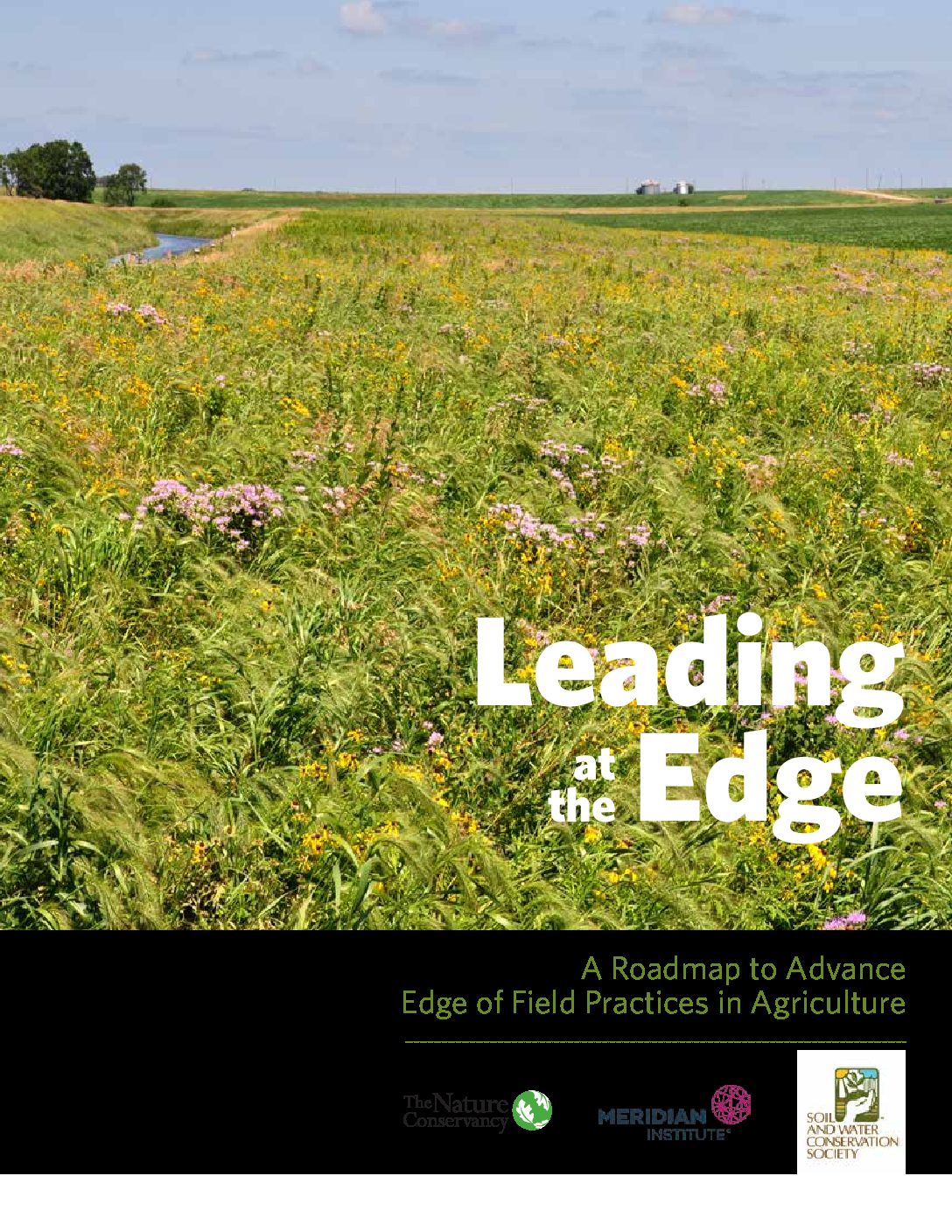
Leading at the Edge: A Roadmap to Advanced Edge of Field Practices in Agriculture
The Nature Conservancy, Meridian Institute, Soil and Water Conservation Society (2022)
Patûrage
Adaptive multi-paddock grazing improves water infiltration in Canadian grassland soils
Dobert et al. (2021). Elsevier.
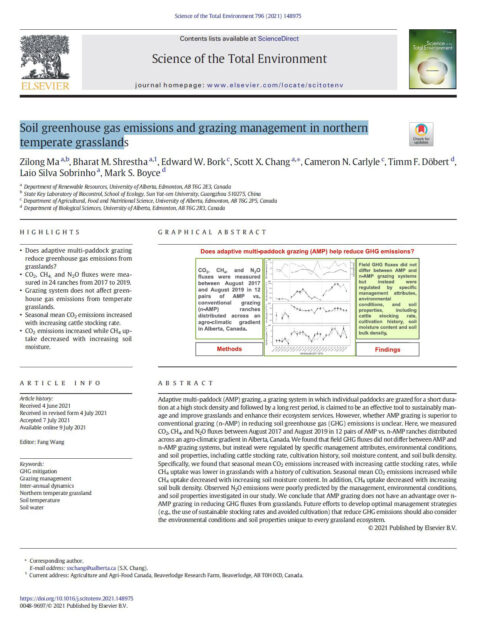
Soil greenhouse gas emissions and grazing management in northern
temperate grasslands
Ma et al. (2021). Elsevier
Pollinisation
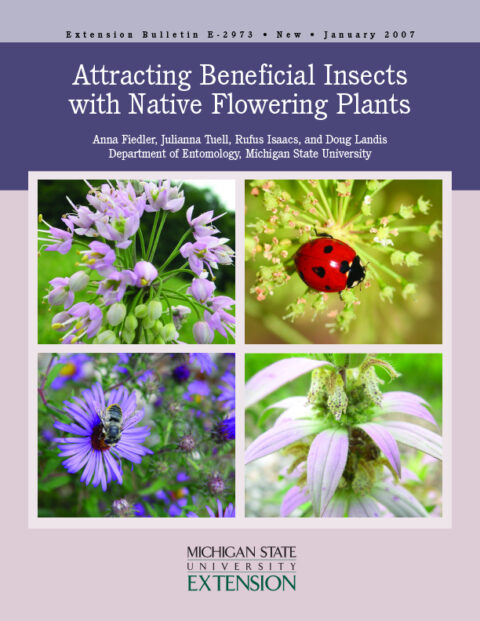
Attracting Beneficial Insects with Native Flowering Plants
Anna Fiedler, Julianna Tuell, Rufus Isaacs, and Doug Landis, Department of Entomology, Michigan State University (2007)
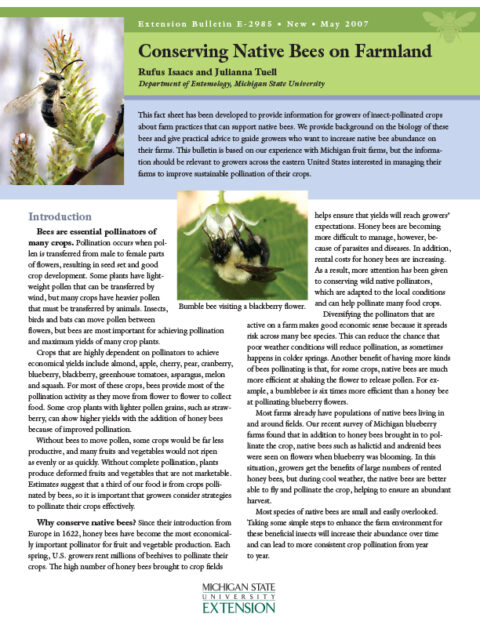
Conserving Native Bees on Farmland
Rufus Isaacs and Julianna Tuell, Department of Entomology, Michigan State University (2007)
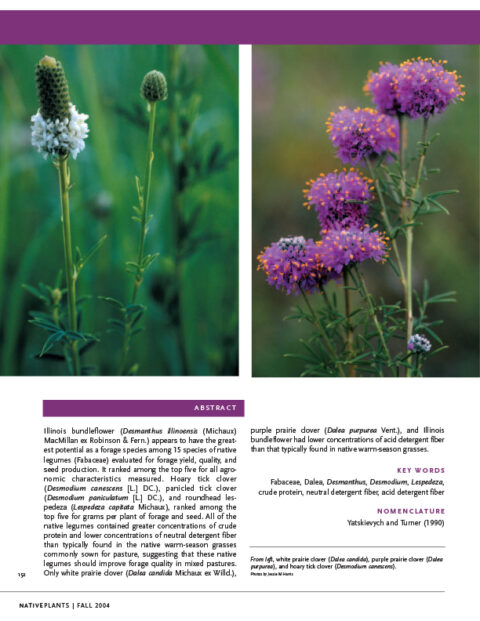
Evaluation of Native Legume Species for Forage Yield, Quality, and Seed Production
Robert L McGraw, Floyd W Shockley, John F Thompson, and Craig A Roberts (2004)
Evidence for decline in eastern North American bumblebees (Hymenoptera: Apidae), with special focus on Bombus affinis Cresson
Sheila R. Colla, Laurence Packer (2008)
Visitation by Wild and Managed Bees (Hymenoptera: Apoidea) to Eastern U.S. Native Plants for Use in Conservation Programs
Julianna K. Tuell, Anna K. Fielder, Douglas Landis, and Rufus Isaacs (2008)
Water Quality and Riparian Buffers
Cost-effective targeting of riparian buffers to achieve water quality and wildlife habitat benefits
Study by Wanhong Yang, Wenbao Liu, Yongbo Liu, Robert C. Corry and Reid D. Kreutzwiser (2014)
Rapports Annuels ALUS
ALUS Annual Report 2024-25
Rapport Annuel ALUS 2025-26
Plans stratégiques ALUS
Plan Stratégique ALUS 2025-26
Nos plus récentes initiatives en innovation
Quand attendre peut sauver une espèce
Parfois, la conservation ne consiste pas à en faire plus, mais simplement à attendre.Chaque printemps, George et Melaney Matheson voient revenir des visiteurs familiers dans leurs champs de foin.Les goglus des prés sont de retour.Après avoir parcouru des milliers de...
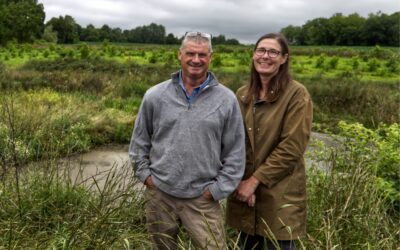
Honorer l’excellence en intendance agroenvironnementale : annonce des lauréats du prix Dave Reid 2025
ALUS est fière d'annoncer les lauréats du prix Dave Reid 2025, qui rend hommage aux producteurs agricoles d’exception à travers le pays. Leur leadership reflètent bien les principes directeurs et les valeurs qui guident ALUS.Chris et Vivian Crump, lauréats du prix...
Les projets fondés sur la nature d’ALUS séquestrent le carbone pour Bruce Power
Le deuxième rapport annuel complété par ALUS pour le compte de Bruce Power vient d’être publié. Il met en évidence les retombées positives de la séquestration du carbone et les bienfaits environnementaux produits par les projets agricoles fondés sur la nature exécutés...
Nos partenaires de recherche

Dr. Wanhong Yang
Professor in the Department of Geography, Environment and Geomatics
Dr. Yang’s work, using his Integrated Modelling for Watershed Evaluation of BMPs (IMWEBs) application, validates the efficacy of ALUS project sites and will ultimately become an effective modelling and analysis tool for decision-makers across Canada to evaluate the benefits of the ALUS program as a cost-effective natural infrastructure solution that also fosters biodiversity.
In Ontario, Dr. Yang is conducting a cost-benefit analysis to evaluate the effectiveness of ALUS projects for phosphorus reduction within the priority regions identified by the Great Lakes Protection Initiative. This research is supported by a grant from the Ministry of Environment and Climate Change Canada (ALUS Norfolk, ALUS Middlesex and ALUS Chatham-Kent). In Alberta, Dr. Yang’s work is focused on the Modeste subwatershed of the North Saskatchewan River, which the Government of Alberta has identified as being a high priority for flood mitigation and water quality, and a moderate-high priority for drought. This research is supported by a grant from Alberta Environment and Parks’ Watershed Resiliency and Restoration Program (WRRP). With funding from the RBC Tech for Nature program, Dr. Yang has extended his modelling into three sub-watersheds in the Lake Erie Basin.
Watershed Evaluation Group, Dr. Wanhong Yang’s research program
Dr. Wanhong Yang receives 2018 Weston Family Ecosystem Innovation Award
About the Modeste Natural Infrastructure Project
Progress in Modeste Natural Infrastructure Project

Dr. Andrew MacDougall
Professor & Head of the MacDougall Ecology Lab, Department of Integrative Biology
Dr. Andrew MacDougall and his team at the MacDougall Ecology Lab at the University of Guelph’s Department of Integrative Biology, are studying the efficacy of ALUS’ prairie restoration sites in southwestern Ontario (primarily in ALUS Norfolk and ALUS Elgin) and quantifying the ecosystem services being produced including biodiversity, carbon sequestration and nutrient retention. Their research has confirmed the positive impact of ALUS projects for pollinators and beneficial insects—indicating a 300% increase in pollinators and beneficial insects after project establishments. The Lab’s research has also confirmed that ALUS projects:
• provide critical habitat for arthropods and promote biodiversity in agroecosystems.
• serve as a soil carbon sink/storage.
• impede 50-100% of nutrients from synthetic fertilizers, especially nitrogen and phosphorus, from leaching into ground and surface waters.
Dr. Amy Newman
Associate Professor & Head of the Newman Lab, Department of Integrative Biology
Dr. Amy Newman and her team at the Newman Lab at the University of Guelph’s Department of Integrative Biology studied avian biodiversity on ALUS farms in southern Ontario and worked with producers who are excited about the interface between restoration, preservation, and agricultural production. Dr. Newman’s research has validated the efficacy of ALUS project sites – confirming that bird species’ diversity and soil microorganisms significantly increase on ALUS projects sites. Her research on ALUS project sites has created a direct link to participants, piquing their interest and efforts to produce more biodiversity through their ALUS projects.
Amy Newman wins the The 2020 Weston Family Research Innovation Award
Dr John Fryxell
Professeur et directeur exécutif de l’Institut de la biodiversité de l’Ontario
Le Dr John Fryxell, du département de biologie intégrative de l’Université de Guelph, travaille sur la recherche en génomique des écosystèmes en recueillant des données sur 30 sites du sud de l’Ontario, allant de terres cultivées intensivement à des zones de restauration ALUS. Les travaux du Dr Fryxell fourniront des données approfondies sur l’ensemble des facteurs influençant la biodiversité des arthropodes et des insectes aquatiques en relation avec les pratiques agricoles, les variations climatiques, les caractéristiques physiques et l’hétérogénéité du paysage. Ces travaux permettront d’établir une méthodologie normalisée pour la surveillance de la biodiversité et l’évaluation de l’impact environnemental, d’identifier les principales incertitudes concernant les mesures sur le terrain fondées sur des méthodologies basées sur l’ADN, et de définir un cadre pour l’alerte précoce des épidémies d’insectes nuisibles et/ou du déclin des espèces d’insectes bénéfiques.

Dr Nigel Raine
Professeur, titulaire de la chaire de la famille Rebanks sur la conservation des pollinisateurs et chef du Nigel Raine Lab, école des sciences de l’environnement
Le Dr Nigel Raine, titulaire de la chaire de la famille Rebanks pour la conservation des pollinisateurs à l’Université de Guelph, a dirigé une étude de trois ans visant à documenter la richesse en espèces et l’abondance des pollinisateurs indigènes en Ontario, afin d’établir des données de référence pour suivre le déclin et les causes des pertes de pollinisateurs dans les années à venir. Le laboratoire Nigel Raine mène actuellement des études préliminaires sur les pollinisateurs indigènes dans plusieurs exploitations agricoles ALUS en Ontario.

Dr Vijay Kolinjivadi
Institut des Sciences de la Forêt tempérée, Université du Québec en Outaouais
ALUS Île-du-Prince-Édouard a travaillé en étroite collaboration avec le Dr Vijay Kolinjivadi, un chercheur de l’Institut des Sciences de la Forêt tempérée (ISFORT) de l’Université du Québec en Outaouais, afin de faciliter la tenue d’entretiens avec les agriculteurs participants à travers l’Î.-P.-É. en 2017. L’ouvrage qui en résulte, ” Putting nature ‘to work’ through Payments for Ecosystem Services (PES) “, a été publié dans Land Use Policy (81, 2019).
Recherche d’ALUS I-P-É publiée dans Land Use Policy (81, 2019) (en anglais)
Institut des Sciences de la Forêt tempérée de l’UQO (ISFORT)
Profil du Dr. Vijay Kolinjivadi

InnoTech Alberta
ALUS works with InnoTech Alberta on the Modeste Natural Infrastructure Project. InnoTech Alberta’s Dr Marian Webber is conducting an economic analysis of the costs and benefits of using nature to deliver infrastructure-related services in the Modeste subwatershed (ALUS Parkland, ALUS Brazeau, and ALUS Wetaskiwin-Leduc). This research is supported by a grant from Alberta Environment and Parks’ Watershed Resiliency and Restoration Program (WRRP).
About the Modeste Natural Infrastructure Project
Progress in Modeste Natural Infrastructure Project

Ministère de l’agriculture et des forêts de l’Alberta
ALUS s’associe avec le ministère de l’agriculture et des forêts de l’Alberta pour mener à bien plusieurs projets de recherche. Par exemple, Karen Raven, responsable de l’unité d’utilisation des terres, et David Speiss, responsable des systèmes d’information géographique, ont mené une recherche en sciences sociales sous la forme d’un processus de cartographie décisionnelle multicritères avec certains comités consultatifs de partenariat ALUS en Alberta.
Ministère de l’agriculture et des forêts de l’Alberta (en anglais)

The Ontario Badger Project
ALUS collabore avec l’équipe de rétablissement du blaireau pour aider à réintroduire le blaireau d’Amérique en Ontario. Autrefois très répandue, l’espèce a souffert de la fragmentation de son habitat et est maintenant classée comme étant en voie de disparition, tant au niveau fédéral que provincial, en Ontario, où il ne reste plus que 200 blaireaux (chiffres de 2018). L’équipe de rétablissement du blaireau procède au radiopistage des blaireaux dans 28 exploitations agricoles d’ALUS Norfolk, afin de suivre leurs déplacements et d’étudier leur habitat et leurs habitudes. Les personnes qui aperçoivent un blaireau ou trouvent un terrier de blaireau sur leurs terres sont invitées à le signaler au projet Ontario Badger en appelant au 877-715-9299 ou en envoyant un courriel à [email protected].